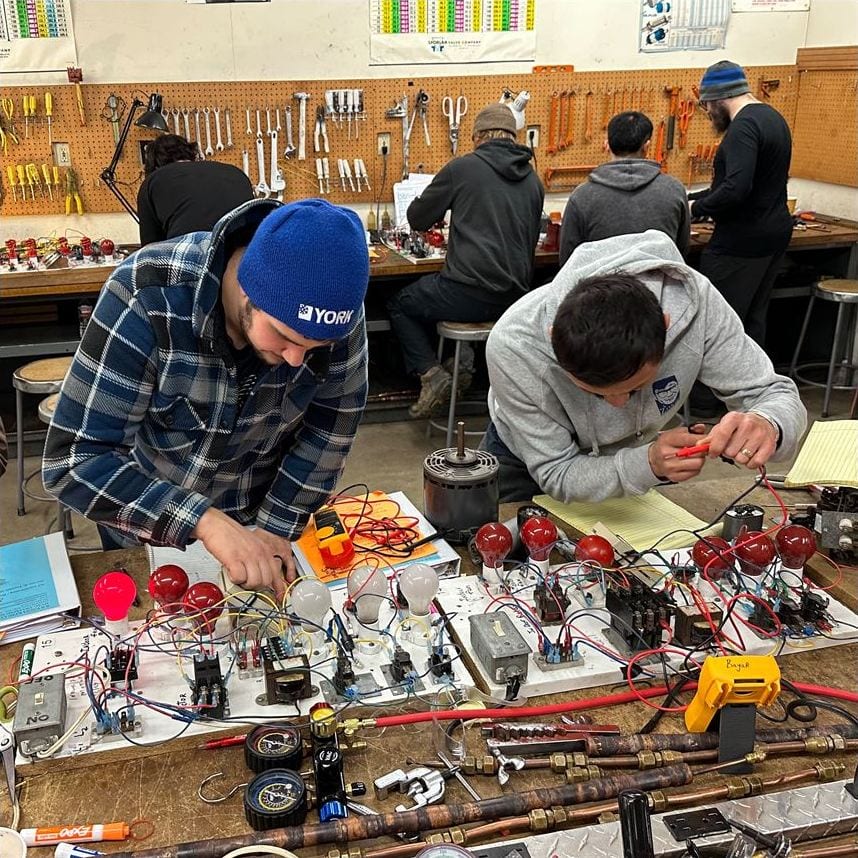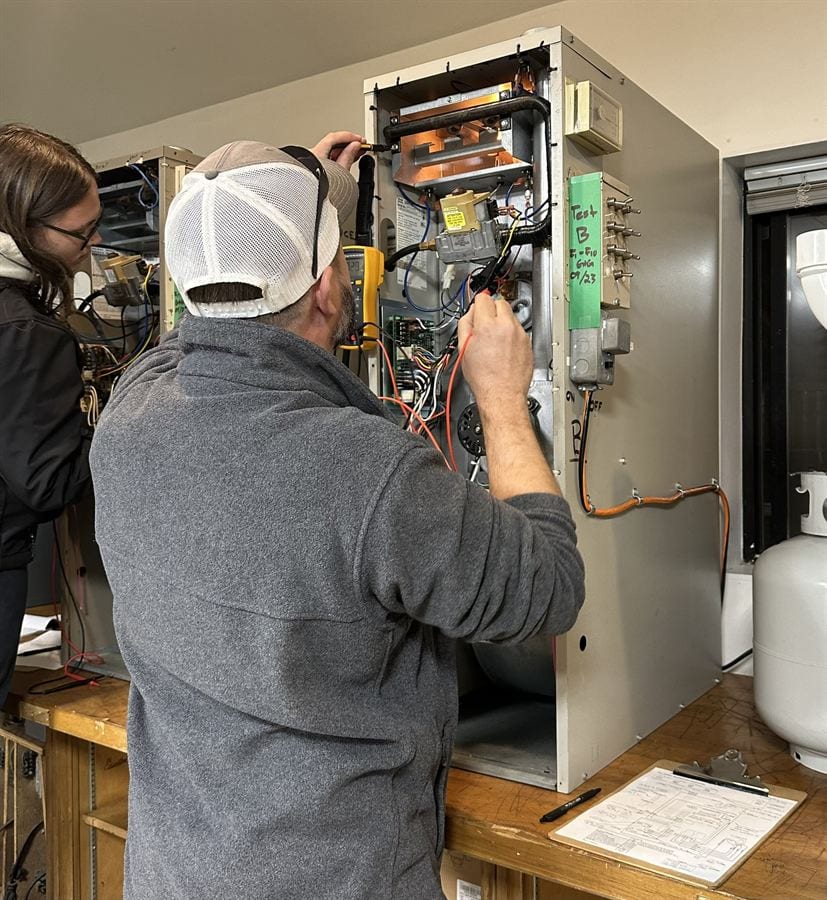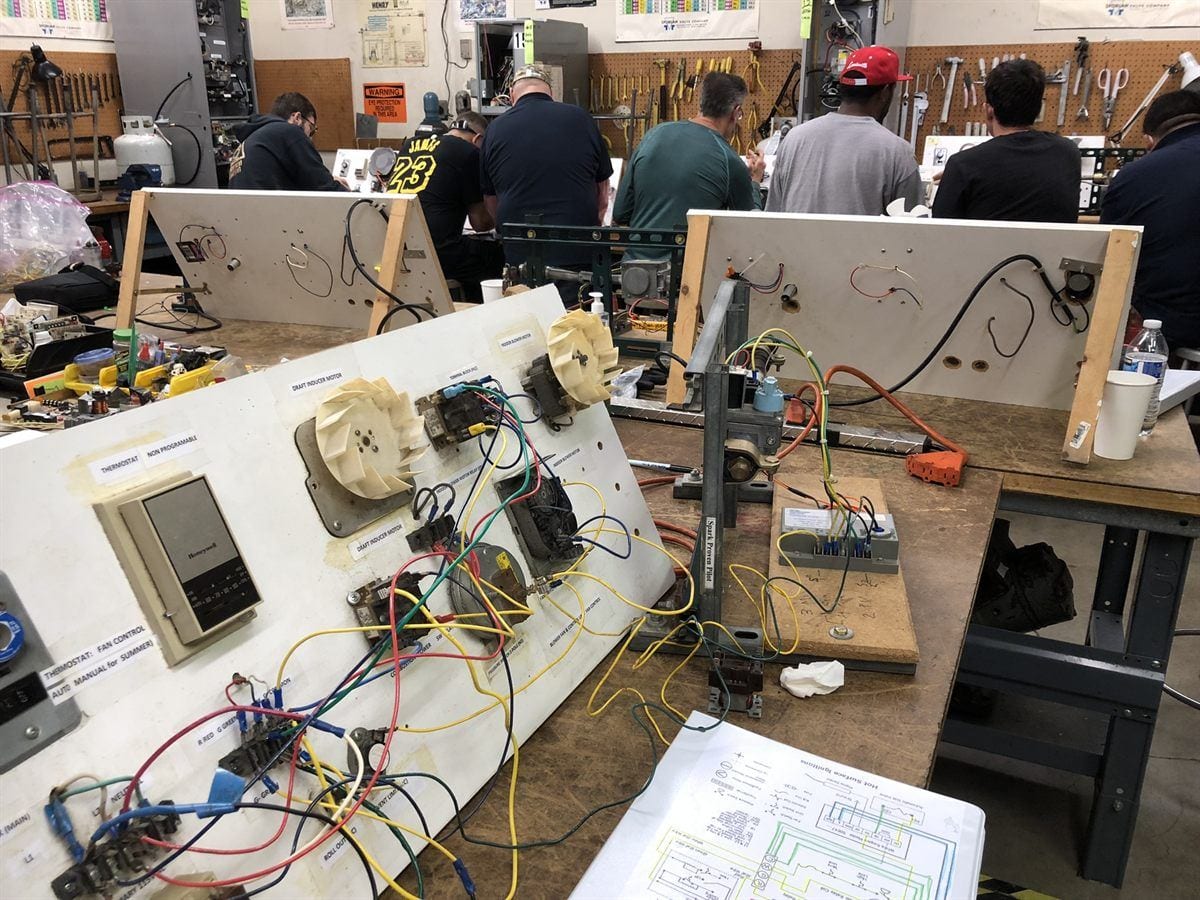
HVAC School student working inside an upright diagnostic gas furnace during a hands-on no-heat service call simulation
Troubleshooting GS 102

Gas Furnace Service & Electrical Troubleshooting

90% hands on. Real furnaces. Real faults. A year’s worth of no-heat service calls condensed into one fast-paced course, with graduates able to diagnose a furnace in six minutes or less.

See upcoming start dates ↓

Upcoming GS 102 start dates

Live from the schedule. Day and evening sections post throughout the year.

Loading upcoming sessions…

Don’t see a date that works? Call (425) 778-2510 or view the full schedule.

Home / Courses / Gas Furnace Troubleshooting

Course details

Curriculum, tools, schedule, and tuition breakdown. Enrollment and upcoming dates are above.

Why this course exists

Service work in the HVAC trade is roughly 75%+ electrical problems, and it takes a disciplined procedure to diagnose those failures correctly and efficiently. The fastest way to build that skill is to put your hands and head on real systems under seasoned professionals using a structured approach.

GS 102 focuses on practical application of line and low-voltage controls on gas furnaces. By the time you finish, you should be able to correctly diagnose a furnace fault in six minutes or less.

Who this course is best for
  • New entry-level HVAC technicians who want confidence on residential and light-commercial gas heat.
  • Anyone trying to enter the HVAC trade and looking for a fast, hands-on first course.
  • Anyone who wants to learn how to use a VOM meter and electrically troubleshoot real equipment.
  • Working techs who struggle with electrical diagnostic and want a proven way to get fast.
What you’ll learn
  • Furnace components: function, operation, and testing.
  • Sequence of operation for standing pilot, spark ignition, and hot-surface ignition systems.
  • Single-stage, multi-stage, 80%, and 90%+ furnaces.
  • Using electrical test meters: voltage, continuity, amperage, and capacitor testing.
  • Reading and following electrical wiring diagrams.
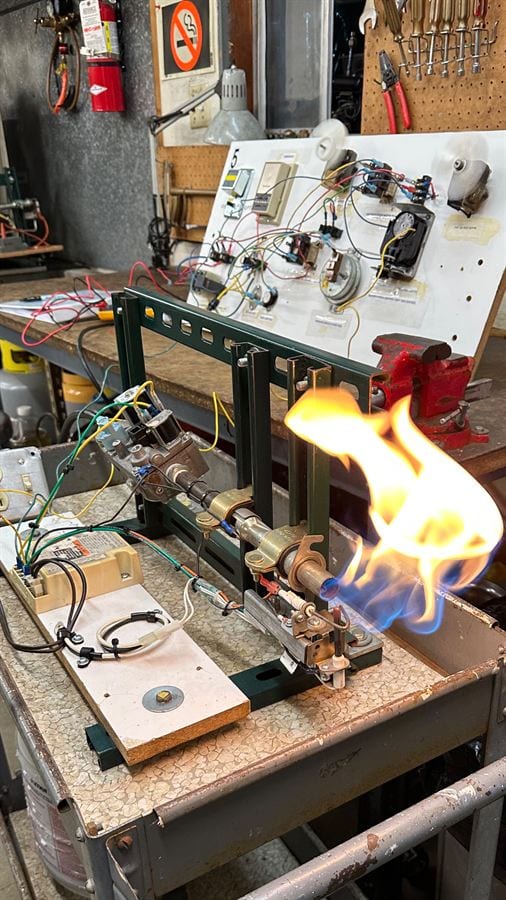
  • Furnace wiring start to finish, including ignition control modules and burner assemblies that actually fire.
  • Electrical diagnostic with the Hopscotch procedure, with a target of six minutes or less per service call.
  • 100+ simulated no-heat service calls on the school’s diagnostic furnaces.
  • Furnace startup procedures, setting gas pressure, and setting fan speed.
  • Complete maintenance for 80% and 90%+ furnaces, plus common replacement parts and repairs.
  • CO testing and combustion safety basics.
  • Customer soft skills: upsells, add-ons, replace vs. repair, and maintenance conversations.
  • Final exam: troubleshoot 10 service calls 100% correct in less than an hour.
How we teach electrical troubleshooting

This is a 90% hands-on course. The path runs from basic electricity, to wiring up real circuits, to troubleshooting bench boards, and finally to diagnosing live furnaces, in the same order a tech learns the trade in the field.

1. Wiring boards

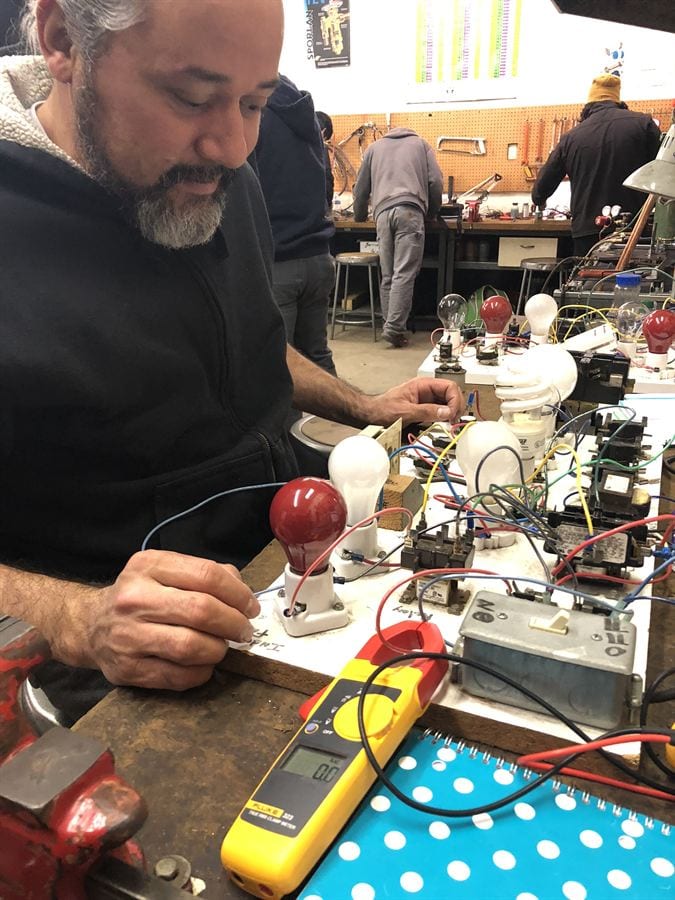
Once the basic electrical circuit and reading wiring diagrams are established, students get wiring boards loaded with real, functioning components. Wire by wire, students physically connect components and build circuits that actually work when wired correctly. They wire three different ignition systems against the diagrams:

  • Standing pilot
  • Spark ignition
  • Hot-surface ignition

2. Hopscotch troubleshooting

Once the wiring boards are mastered, students move to troubleshooting boards wired to the same diagrams they already know. Now instead of building circuits, they trace electricity through them. Built-in fault switches fail a component electrically and produce the same readings as a real failure in the field.

3. Diagnostic furnaces

Each diagnostic furnace contains 10 designed electrical failures. With every fault off, the unit operates as a normal working furnace. Students must complete a minimum of 100 simulated no-heat service calls using just their meter and the wiring diagrams. Final exam: 10 faults in 60 minutes, 100% accuracy.

Curriculum at a glance

Six chapters, weighted heavily toward electrical content because that is where most service calls live. Total: 110 electrical questions · 23 non-electrical · 129 total.

Ch 1 · 14 Q

Basic electrical review

Ch 2 · 9 Q

Heat transfer

Ch 3 · 38 Q

Components, part 1

  • Heat exchanger
  • Gas valve
  • Standing pilot
  • Thermocouple
  • Blower motor
  • Transformer
  • Fan / limit switch
Ch 4 · 30 Q

Components, part 2

  • Relays
  • Thermostats
  • Safeties
  • Pressure switches
  • Burners
Ch 5 · 17 Q

Sequence of operation

  • Standing pilot
  • Direct spark / proven pilot
  • Hot-surface ignition
Ch 6 · 25 Q

Troubleshooting furnaces

  • Standing pilot furnace
  • Direct spark / proven pilot
  • Hot-surface ignition
Hours, schedule & class size
  • Course code: GS 102
  • Total hours: 40 hours
  • Format: Day (1 week) or evening (2 weeks) sections available
  • Required tool: Fluke 116 multimeter
  • Location: Brier, WA campus
Tuition, deposit & payment
  • Tuition: $2,995, books & lab materials included
  • $100 deposit holds your seat (refundable within 5 business days of signing)
  • $2,895 balance due on day one (check, card, or cash)
  • Fluke 116 meter required on day one

Day and evening sections fill on a first-come basis, so call if you want us to hold a seat.

Pairs well with

Many techs follow GS 102 with the air-conditioning side of the trade. These pair naturally:

  • ACHP 105, 96 hours of fundamentals: refrigeration, brazing and flaring, electrical, and live system service.
  • RS 103, 48 hours of focused service work on residential AC and heat-pump systems.

Still scrolling? The seat is one click away.

Your application is pre-filled for GS 102 when you click through. Call if you’d rather talk first. A real person picks up.